.png)
Details
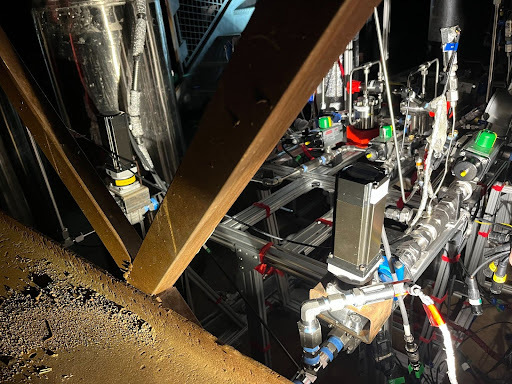
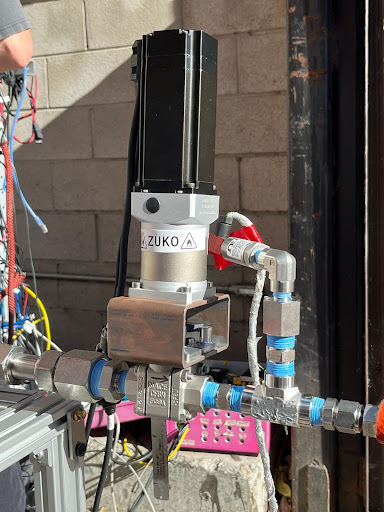
The throttle system is one of LPL's most novel and unique solution to the challenging problem of controlling the thrust output of a liquid rocket engine. Designed around the 3 kN kerosene-liquid oxygen engine Nomad, the throttle system consists mainly of two V-port ball valves, one on each propellant line, to control the propellant flow rate into the engine's injector. The valve is actuated with the Nema 23 Stepper Motor and coupled using an in-house design. The actuator also comes with an optical encoder for positional feedback, and the coupler design includes hard stops for redundancy to ensure the valve is limited to 90 degrees of motion.
The control loop for the throttling system is closed-loop and receives feedback from pressure transducers and thermocouples throughout the propellant lines for fine control of thrust and mixture ratio. The sensor data feeds into a hybrid control strategy combining PID feedback with a feed-forward model derived from testing. The feed-forward term anticipates system behavior and the PID loop corrects deviations resulting in smoother and more stable throttle transitions. The controller has two separate PID control loops for each propellant that feed into a larger overall control loop for thrust and mixture ratio. Some challenges with this method are the calculation of cryogenic flow rate for liquid oxygen using only pressure and temperature data at varying throttle positions. The control algorithm was initially tuned with open-loop characterization hot fires, and then used the system's behavior to tune a closed-loop algorithm for a flight application on LPL's liquid rocket hopper, Ranger 1.
.png)